

Falls are the leading cause of emergency room visits in the United States, accounting for over 8 million ER trips each year. A wet floor in a grocery store, a crumbling stairway in an apartment complex, a poorly lit parking lot — these are preventable hazards, and when property owners fail to address them, they should be held accountable.
If you were injured in a slip and fall on someone else’s property in Phoenix, Arizona law may entitle you to significant compensation. At Leon Law, PLLC, founding attorney Jose M. Leon has spent 14+ years holding negligent property owners, businesses, and landlords responsible.
Call (480) 269-1083 or request a free case review today. We work on a contingency-fee basis — you pay nothing unless we win.
Premises liability holds property owners and occupiers responsible for injuries caused by unsafe conditions on their property. In Arizona, anyone who owns, leases, or controls property has a legal duty to keep it reasonably safe. When an owner fails to maintain safe conditions or warn of a known hazard, and someone is injured, the owner can be held liable.
Arizona is one of the states that still uses the traditional classification system to determine the level of care a property owner owes. The duty of care depends on why you were on the property:
An invitee enters the property for a business purpose — a customer in a store, a patient in a medical office, a diner in a restaurant. Property owners owe invitees the highest duty of care: regularly inspecting for hazards, repairing dangerous conditions promptly, and warning of hazards that cannot be immediately fixed.
A licensee enters with the owner’s permission for a social purpose, such as a dinner guest. The property owner must refrain from willful or wanton conduct and warn of known hidden dangers. A higher duty may apply to child guests.
A trespasser enters without permission. Property owners generally owe trespassers only the duty not to cause intentional harm. Under the attractive nuisance doctrine, a higher duty may be owed to trespassing children when the property contains features likely to attract them (swimming pools, construction equipment, etc.).
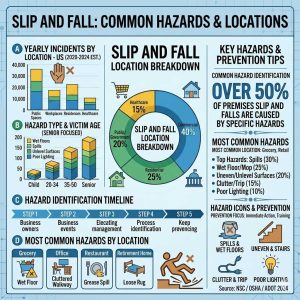 Slip-and-fall accidents happen anywhere, but certain locations see a disproportionate share:
Falls may look minor, but the injuries they cause are often severe:
To win a premises liability case, you generally need to prove three things:
Property owners often argue the hazard was “open and obvious.” An experienced slip and fall lawyer knows how to counter these defenses.
If a property owner’s negligence caused your fall, you may be entitled to:
Slip-and-fall cases live and die on evidence. Take these steps as soon as possible:
Arizona’s pure comparative negligence rule (A.R.S. § 12-2505) allows you to recover damages even if you were partially at fault. Your compensation is reduced by your percentage of responsibility — if you are found 30% at fault on $100,000 in damages, you receive $70,000. Insurance companies argue this defense aggressively, making skilled legal representation essential.
If your fall occurred on government property — a public sidewalk, city building, or county facility — you must file a notice of claim within 180 days under A.R.S. § 12-821.01. Missing this deadline can permanently bar your claim. Contact an attorney immediately.
Under A.R.S. § 12-542, you have two years from the date of your fall to file a lawsuit. For minor children, the statute may be tolled until age 18 (A.R.S. § 12-502). Do not assume you have time — surveillance video is overwritten quickly, witnesses forget details, and property owners may repair the hazard.
| Private Property Claim | Government Property Claim | |
|---|---|---|
| Examples | Grocery store, apartment, restaurant, parking lot | Public sidewalk, city park, county building, school |
| Notice Requirement | None — file lawsuit directly | Written notice of claim within 180 days (A.R.S. § 12-821.01) |
| Lawsuit Deadline | 2 years from date of fall (A.R.S. § 12-542) | 1 year from date of fall after notice is filed |
| Fault Standard | Pure comparative negligence (A.R.S. § 12-2505) | Same comparative fault rules apply |
| Damages Cap | None — full compensation available | May apply depending on entity and claim type |
Whether your fall happened in a private business or on public property, call (480) 269-1083 immediately. Deadlines in government cases can pass in weeks — not years.
A: You need to show the property owner knew or should have known about the hazard and failed to fix it or warn you. Surveillance footage, witness statements, maintenance logs, and prior complaints can establish negligence.
A: Arizona’s pure comparative negligence law (A.R.S. § 12-2505) allows you to recover damages even if you share some fault. Your award is reduced by your percentage of responsibility.
A: You generally have two years under A.R.S. § 12-542. If the fall happened on government property, you must file a notice of claim within 180 days under A.R.S. § 12-821.01. Contact a premises liability attorney promptly to protect your rights.
A: Yes, but you must act fast. A.R.S. § 12-821.01 requires a written notice of claim within 180 days. Missing this deadline can permanently bar your claim.
A: Any injury caused by a property owner’s negligence may qualify — broken bones, hip fractures, brain injuries, spinal cord damage, torn ligaments, and more. Even soft-tissue injuries can justify significant compensation if they limit your ability to work.
A: No. We handle all personal injury cases, including slip and fall claims, on a contingency-fee basis. You owe us nothing unless we win. Call (480) 269-1083 or submit a free case review to get started.
Property owners have a duty to keep their premises safe. When they fail, you should not pay the price alone. Leon Law, PLLC has 14+ years of experience holding negligent property owners accountable. Call (480) 269-1083 or complete our free case review form for a free consultation — available 24/7.

Law is a complicate matter. It can cause you a big problem
if you ignore it. Let us help you!