Construction is one of the most dangerous industries in America — and in a booming market like Phoenix, the risks are constant. Scaffolding collapses, crane accidents, trench cave-ins, falling tools, electrical hazards, and equipment failures injure and kill workers every year on Valley job sites.
Workers’ compensation provides some protection, but it rarely covers the full cost of a serious construction injury. A third-party negligence claim — filed against a property owner, general contractor, subcontractor, or equipment manufacturer — can provide significantly larger compensation than workers’ comp alone allows.
At Leon Law, PLLC, founding attorney Jose M. Leon has spent 14+ years representing seriously injured workers and their families throughout Phoenix and Maricopa County. We handle construction accident cases on a contingency-fee basis — you pay nothing unless we win.
Call (480) 269-1083 or complete our free case review form today.
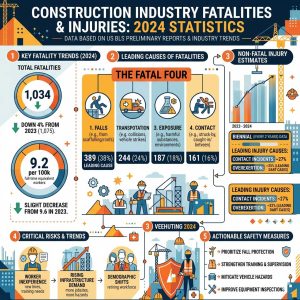 Construction remains the deadliest private-sector industry in the United States. According to the U.S. Bureau of Labor Statistics Census of Fatal Occupational Injuries (CFOI) and OSHA 2024 data:
1,032 construction and extraction workers were killed on the job in the United States in 2024 — roughly 20 fatalities per week (BLS CFOI, 2024)
Construction accounts for 19% of all U.S. worker deaths — the highest fatality share of any industry
370 construction workers died from falls, slips, and trips in 2024 alone — the single leading cause of construction fatalities
26 construction workers were killed in Arizona in 2023 (the most recent state-level data), with falls and exposure to harmful substances each accounting for 9 of those deaths (BLS, Arizona Fatal Work Injuries)
More than 65% of construction deaths are caused by the OSHA ‘Fatal Four’: falls, struck-by-object, electrocution, and caught-in/between incidents
The fatal injury rate for construction and extraction workers is 40 per 100,000 workers — among the highest of any occupation
Arizona’s construction boom — driven by semiconductor manufacturing, data centers, residential development, and highway expansion — means thousands of workers are on active job sites across the Phoenix metro every day. More activity means more exposure to risk.
OSHA has identified four hazard categories responsible for the majority of construction fatalities nationwide. In Arizona, these same hazards dominate construction site injuries:
|
#1 Leading Cause
Falls Falls from scaffolding, rooftops, ladders, open floor edges, and elevated platforms. Accounted for 370 construction deaths nationally in 2024. Fall protection failures — missing guardrails, improper scaffolding, defective harnesses — are the #1 OSHA citation category. |
#2 Leading Cause
Struck by Object Tools, materials, and debris falling from elevated work areas. Swinging crane loads, backing vehicles, and airborne projectiles. Even a small object dropped from height generates lethal force. |
|
#3 Leading Cause
Electrocution Contact with overhead power lines, exposed wiring, energized equipment, and unmarked underground utilities. Electrocution on construction sites is often preventable with proper lockout/tagout procedures and utility locating. |
#4 Leading Cause
Caught-In/Between Workers caught in or compressed by equipment, materials, or collapsing structures. Trench collapses, unguarded machinery, and equipment pinch points are common causes. Trench cave-ins can bury a worker in seconds. |
If you were injured on a construction site, you almost certainly have a workers’ compensation claim through your employer. But workers’ comp has serious limitations — it does not cover pain and suffering, and it caps lost wage benefits well below your actual earnings.
A third-party negligence claim is filed separately against a party other than your employer — such as a general contractor, subcontractor, property owner, or equipment manufacturer — whose negligence caused or contributed to your injury. Third-party claims are not limited by workers’ comp caps and can include the full range of damages including pain and suffering.
| Factor | Workers’ Compensation | Third-Party Negligence Claim |
|---|---|---|
| Filed Against | Your employer’s insurer | Negligent third party (contractor, owner, manufacturer) |
| Covers Medical Bills | Yes | Yes |
| Lost Wages | Capped — typically 66⅔% of wages | Full lost wages + future earning capacity |
| Pain & Suffering | Not covered | Fully recoverable |
| Proof Required | Injury occurred at work — no fault needed | Must prove third party’s negligence caused injury |
| Can You Pursue Both? | Yes — Arizona allows workers to pursue both simultaneously | |
Construction sites involve multiple parties with overlapping responsibilities. Depending on the facts of your accident, these parties may bear legal liability:
Statute of Limitations (A.R.S. § 12-542): You have two years from the date of your construction accident to file a personal injury lawsuit. For wrongful death claims, the two-year period runs from the date of death. Missing this deadline permanently bars your claim.
Government entity claims (A.R.S. § 12-821.01): If a government entity contributed to your accident — for example, a state highway department negligently designed a work zone — you must file a written notice of claim within 180 days. This deadline runs concurrently with the two-year statute and is strictly enforced.
Pure comparative negligence (A.R.S. § 12-2505): Arizona’s pure comparative fault system allows you to recover damages even if you were partially at fault — for instance, if you failed to wear required PPE. Your award is reduced by your percentage of responsibility, but you are not barred from recovery.
OSHA violation as evidence: A finding by the Arizona Division of Occupational Safety and Health (ADOSH) or federal OSHA that the site was in violation of safety regulations is powerful evidence of negligence. Leon Law investigates OSHA inspection records, citations, and penalty history as part of every construction accident case.
Yes. Workers’ compensation prevents you from suing your direct employer, but it does not bar you from pursuing a third-party negligence claim against a general contractor, property owner, subcontractor, or equipment manufacturer whose negligence caused your injury. These third-party claims are not limited by workers’ comp caps and can include pain and suffering damages.
Yes. Arizona allows injured workers to pursue both claims simultaneously. Your workers’ comp benefits may be reduced by any third-party recovery, but combining both avenues typically results in significantly higher total compensation than workers’ comp alone. Leon Law handles both tracks and coordinates them to maximize your recovery.
An OSHA citation is strong evidence of negligence in a civil lawsuit. While the citation itself may not be admissible in some courts, the underlying safety violation and facts documented in the OSHA inspection report absolutely can be. Leon Law routinely uses OSHA records, site inspection photos, and penalty documentation to build construction accident cases.
Yes. Arizona law does not bar undocumented workers from pursuing workers’ compensation or third-party negligence claims for construction injuries. Your immigration status does not affect your right to compensation for injuries caused by another party’s negligence. All consultations with Leon Law are confidential.
Under A.R.S. § 12-542, you have two years from the date of injury to file a personal injury lawsuit. If a government entity is involved, you must file a written notice of claim within 180 days (A.R.S. § 12-821.01). Construction accidents often involve multiple parties, complex insurance coverage, and physical evidence that disappears quickly — contact an attorney as soon as possible.
Surviving spouses, children, parents, or personal representatives of the estate may file a wrongful death claim under A.R.S. § 12-612. Recoverable damages include funeral and burial costs, lost income, loss of companionship, and the deceased’s pain and suffering prior to death. The two-year statute of limitations runs from the date of death. Leon Law handles construction wrongful death cases with the depth of investigation these cases require.
Call (480) 269-1083 or complete our free case review form for a confidential, no-obligation consultation. Available 24/7. No fee unless we win.

Law is a complicate matter. It can cause you a big problem
if you ignore it. Let us help you!