

Uber, Lyft, and other rideshare services have become part of daily life in Phoenix. Millions of rides are completed every year. But when a rideshare vehicle is involved in a crash, figuring out who pays — and how much insurance applies — is far more complicated than a standard car accident claim.
If you were hurt in a rideshare accident in Phoenix — whether as a passenger, another driver, a pedestrian, or a cyclist — Leon Law, PLLC can help. Attorney Jose M. Leon has 14+ years handling complex motor-vehicle injury claims, and our firm has written extensively about rideshare accident issues on our blog. We fight for the full compensation you deserve.
Call (480) 269-1083 or request a free case review today. You pay nothing unless we win.
Phoenix’s sprawling geography and limited public transit make it one of the top rideshare markets in the country. With more rideshare vehicles on the road than ever — including autonomous ride-hail services — the number of accidents involving Uber and Lyft drivers continues to climb.
Rideshare crashes affect more than just the people inside the vehicle:
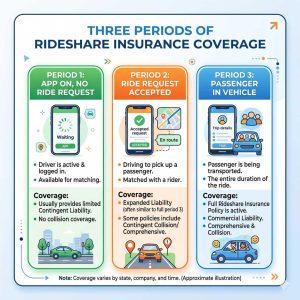 The most critical — and most disputed — question after a rideshare accident is: which insurance applies? The answer depends entirely on the driver’s app status at the moment of the crash. Arizona law (A.R.S. § 28-4038) and company policies recognize three distinct periods:
When the Uber or Lyft app is turned off, the driver is a private motorist. The rideshare company provides zero coverage. Only the driver’s personal auto insurance applies.
This coverage only activates if the driver’s personal policy does not apply. Many personal auto policies exclude commercial driving — creating dangerous gaps.
This is when the highest coverage applies. Once a driver accepts a ride and throughout the trip, both Uber and Lyft maintain:
This $1 million policy is the most important coverage for injured passengers and third parties. It is primary coverage, meaning it pays first, before any personal policy.
Rideshare crashes involve layers of complication that standard car accident claims do not:
An experienced personal injury lawyer can investigate the driver’s app records, obtain the correct insurance policy information, and hold all responsible parties accountable.
Depending on the severity of your injuries, you may be entitled to:
Rideshare crashes involve layers of complication that standard car accident claims do not. Insurance companies and corporate legal teams use this complexity to limit what they pay. Here is what you are up against:
The driver’s personal policy, the rideshare company’s commercial policy, and potentially a third-party driver’s policy may all be involved — each with different limits and conditions.
Rideshare drivers are classified as independent contractors, not employees. This affects which insurance applies and is used to shield the company from direct liability.
Adjusters may argue about which “period” the driver was in to reduce available coverage. Without app records, these disputes are hard to win on your own.
Uber and Lyft have large legal departments and experienced adjusters whose sole goal is to minimize the company’s exposure. You need an experienced attorney on your side.
An experienced personal injury lawyer can investigate the driver’s app records, obtain the correct insurance policy information, and hold all responsible parties accountable.
| Period | Driver Status | Coverage Level | Who Pays |
|---|---|---|---|
| Period 1 | App off — personal use | None from TNC | Driver’s personal auto insurance only |
| Period 2 | App on — awaiting request | Limited Contingent $50K / $100K / $25K |
Rideshare company — only if personal policy doesn’t apply |
| Period 3 | Accepted ride or passenger on board | $1M Primary + UM/UIM coverage |
Rideshare company’s commercial policy — pays first |
Arizona regulates transportation network companies (TNCs) under A.R.S. § 28-4031 through § 28-4042. Key provisions include:
The statute of limitations for a rideshare accident injury claim in Arizona is two years from the date of the crash (A.R.S. § 12-542). If a government vehicle or road design contributed to the accident, you must file a notice of claim within 180 days (A.R.S. § 12-821.01).
Arizona’s pure comparative negligence rule (A.R.S. § 12-2505) allows you to recover damages even if you were partially at fault — your compensation is reduced by your share of responsibility.
Q: Who pays if I am injured as a passenger in an Uber or Lyft?
A: When you are a passenger during an active ride, the rideshare company’s $1 million liability policy is the primary source of coverage. Your own auto or health insurance should not need to be your first resort. A rideshare accident lawyer can identify every available policy and pursue the maximum payout.
Q: What if the rideshare driver was at fault for the accident?
A: The rideshare company’s commercial insurance covers the driver’s negligence during active rides. During Period 2 (app on, waiting), contingent coverage applies. Your attorney will determine which policy applies based on the driver’s app status at the time of the crash.
Q: Can I sue Uber or Lyft directly?
A: Uber and Lyft classify drivers as independent contractors, which they use to shield themselves from direct liability. However, claims can be made against the insurance policy the company maintains. In some circumstances, additional legal theories may apply. An experienced attorney can evaluate your options.
Q: What if the other driver (not the rideshare driver) caused the crash?
A: You may file a claim against the at-fault driver’s insurance. If that driver is uninsured or underinsured, the rideshare company’s UM/UIM coverage may apply during active rides (Period 3).
Q: How long do I have to file a rideshare accident claim in Arizona?
A: You have two years from the date of the accident under A.R.S. § 12-542 to file a lawsuit. Do not wait — evidence degrades, app records may be deleted, and witnesses become harder to locate over time.
Q: Does Leon Law charge anything upfront for rideshare accident cases?
A: No. We work on a contingency-fee basis. You pay nothing unless we recover money for you. Call (480) 269-1083 for a free consultation.
Rideshare accidents create confusion — multiple insurers, disputed coverage, and corporate legal teams working against you. You need someone on your side who knows how to navigate it. Call Leon Law, PLLC at (480) 269-1083 or complete our free case review form for a no-cost, no-obligation consultation — available 24/7.

Law is a complicate matter. It can cause you a big problem
if you ignore it. Let us help you!